 Consequent upon the Senate’s approval of President Bola Tinubu’s ambassadorial nominees in December 2025, Chief Femi Fani-Kayode, erstwhile Minister of Aviation in the presidency of Chief Olusegun Obasanjo, was listed among the 65 nominees comprising 34 career and 31 non-career diplomats announced by the Federal Government on March 6, 2026, and appointed as Nigeria’s Ambassador to the Republic of Germany.
By late April, however, Fani-Kayode had yet to report in Germany, sparking speculations that he might have been rejected by his host country in inexplicable circumstance, until then Minister of Foreign Affairs, Ambassador Yusuf Tuggar, cleared the air, saying the government had resolved that Nigeria’s High Commissioner to South Africa at the time, Senator Sam Enang, move to Germany while Fani-Kayode replace him as envoy to South Africa.
To justify that his posting to South Africa was in order, Fani-Kayode had said afterwards: “Given the fact that I had lived in Europe most of my life, I would prefer to go to South Africa, which is a country that I had never been to and for which I have so much interest.
“I also expressed the fact that I would rather serve in a country that shares some of my convictions, beliefs and values when it comes to world affairs, that has the biggest economy in Africa, that has closer ties to Nigeria and that is more proximate to my political thinking when it comes to foreign affairs and a pan-African vision.”
The foregoing must have really impressed the South African government, coming from an expected very important visitor, especially in view of the somewhat tense relationship between Nigeria and South Africa following the recent xenophobic incidents for which hundreds of Nigerians had to be evacuated to safety back home from the former apartheid enclave.
But by the time Fani-Kayode arrived in South Africa in August to a warm reception by Nigerians resident in the country, things began to take the shape of what would come in the near future. Rev. Frank Onyekwelu, President of the Nigerian Citizens Association South Africa (NICASA), said in a statement that the association expected Fani-Kayode to draw on his wealth of experience to address the “challenges facing Nigerians living in South Africa.”
The message was unambiguous, and it needed not be stressed further that the envoy was coming at a time when the relationship between Nigeria and South Africa was at an all-time low. Onyekwelu’s charge that the Nigerians living in South Africa believed that Fani-Kayode was “equal to the task” must have pushed the new envoy beyond the limits. Little wonder, he readily assured NICASA that he was in South Africa to protect their interest to the best of his ability, reset and strengthen Nigeria-South Africa bilateral and trade ties, protect the welfare and legal support of Nigerians in South Africa and address xenophobia. In late October, he also met and engaged with members of the Nigerian community in a town hall and the Nigerian Fair in Johannesburg, during which he robustly addressed concerns over xenophobia, safety and consular services.
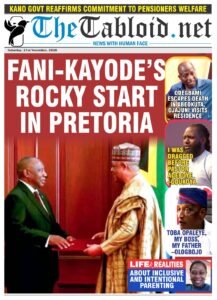
Perhaps, Fani-Kayode had much earlier developed a single-minded approach to discharging his duties, well beyond diplomatic encumbrance. Or he was just too eager to make his presence felt in South Africa, such that he did not reckon that the relationship between Nigeria and South Africa had taken a delicate bent that can only be resolved through strict diplomacy. For instance, the Federal Government had reacted to the recurring xenophobic violence against Nigerians in South Africa through guided condemnation and demands for accountability, which took into consideration a series of engagements between both countries. But by November 13, when he presented his letters of credence to South African President Cyril Ramaphosa alongside 14 other ambassadors and high commissioners, Fani-Kayode had literally thrown diplomacy through the window.
A usually solemn and brief ceremony where the envoys would simply take the podium and present their letters, whereupon they would get a presidential handshake, was turned into a speech-making occasion by the Nigerian envoy, to the amazement of his colleagues in the hall and even more to the bewilderment of President Ramaphosa, who was forced to stand rooted while Fani-Kayode delivered an extempore speech that lasted almost 10 minutes. The focus of the rather lengthy speech, detailing the long-standing South Africa-Nigeria relationship that spanned several sectors of human endeavours, was to express the displeasure of Nigerians with regard to the ill-treatment they received from their host country in recent times.
Rather than try to amend the aforementioned row between Nigeria and South Africa, therefore, Fani-Kayode had sparked a fresh diplomatic row, especially with his remarks on xenophobia in the speech.
Media reports after the presentations of letters of credence said Fani-Kayode accused the South African Presidency and South African Broadcasting Corporation (SABC) of excluding his introduction and speech from the livestream when he presented his letters to President Ramaphosa.
South African presidential spokesperson, Vincent Magwenya, responded immediately, upbraiding Fani-Kayode’s remarks and conduct, even as the SABC also stated that its coverage of the event was independent of the presidential livestream.
The South African Presidency would later upload the full recording of the ceremony, ostensibly to calm frayed nerves. Notwithstanding, the Nigerian High Commission in South Africa and the South African Presidency continued to trade accusations and counter-accusations over the allegation raised by Fani-Kayode. Magwenya directly accused Fani-Kayode of “misrepresenting Ramaphosa’s involvement” in the matter.
The Nigerian High Commission, in its response via X, called Magwenya’s comments “provocative, insolent and diplomatically inappropriate,” also categorically saying the Nigerian envoy and, by extension, Nigeria had been “treated with contempt and disdain.” While calling on President Ramaphosa to intervene in the row, the Nigerian High Commission said to Magwenya: “You are the disgrace and no one else. Outside of that, your insolence and ignorance know no bounds.”
Apparently not willing to let go, Magwenya fired back: “Even when it’s institutionalised, a lie remains a lie. The President will never intervene in the operations of the SABC. Read our constitution and laws, and familiarise yourself with the SABC editorial code. Stop disgracing yourself and your country.”
Bemused observers were left divided on the unfolding drama, however, with some criticising Fani-Kayode for what they called a lack of diplomatic restraint, while others who defended him argued that Nigeria should no longer tolerate disrespect from the South Africans.
A resolution of the logjam may have come on November 17 as Fani-Kayode received a summon from the Director-General of South Africa’s Department of International Relations and Cooperation (DIRCO), Mr. Zane Dangor, who expressed displeasure over the Nigerian High Commissioner’s post-ceremony comments and subsequent social media posts. Reports said Dangor served Fani-Kayode during the meeting a reminder of the latter’s obligations under the Vienna Convention on Diplomatic Relations, that is, to always deploy established diplomatic channels to express his views.
According to the reports, Fani-Kayode described his meeting with Dangor as “cordial and constructive,” even as he reiterated his commitment to strengthening Nigeria-South Africa relations. However, the Nigerian envoy described the meeting as paled into insignificance now; what matters is that he has been schooled that activism and diplomacy are poles apart, and the humility to understand the difference would prove key to his success in South Africa.

Leave a Reply