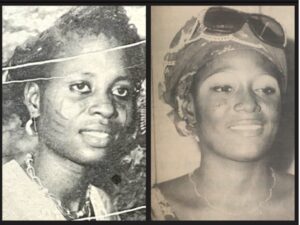
 In 1977, Alake Alasela, an indigene of Ibadan, released her first Fuji album under Lanrewaju Adepoju Records Company. Like all Fuji artists in the 1970s, Alake Alasela ventured into Fuji from existing genres of music. She played both Awurebe and Waka. The following year, Karimotu Aduke, the first wife of Dr. Sikiru Ayinde Barrister and the mother of his first child, Rasaq, released her first Fuji album, after practicing Were for over two decades.
These women Fuji pioneers would be joined by MutiatAmope, Musili Arike, AsisatuAmope, Muinat Ejide, and several others in the 1980s. In 1983, MutiatAmope even did the inconceivable when she established her own record label (MUT Iganmode Records Company) to fight the prejudice that women artists confronted in the entertainment industry.
In Episode II of The Fuji Documentary, produced and directed by US-based Professor Saheed Aderinto, the stories of these women who have been neglected in the chronicle of Fuji come to life. For decades, male Fuji artists consistently refused to acknowledge the pioneering roles of women in Fuji, either by claiming that they didn’t sing Fuji, but Waka or Awurebe (even when their albums are clearly labelled as Fuji) or because they think they didn’t have enough visibility to be respected as legitimate Fuji artists. This historical invisibility is over. Women’s place in Fuji has been restored.
But this documentary goes beyond chronicling the story of women Fuji artists since the 1970s. It unveils the numerous but rarely recognized roles of women in Fuji. Women not only determined the artists invited to social gatherings, but they are also the reasons men spend a lot of money on artists. Unveiling the stories of women as wives, mothers, daughters, spiritual advisers, and everything in-between, “The Women of Fuji,” re-writes the history of Fuji that has centered predominantly on famous male bandleaders.
Listening to the voices of early women Fuji artists and seeing their vintage performances, dating to the 1980s, is as heart-warming as unveiling the wives, daughters, and female fans as they tell the stories of their beloved husbands, fathers, and music idols.We often hear about the roles of mothers of Fuji artists but having the right visual impression and tight-storytelling techniques to place these roles in the right perspectivesis a major artistic intervention.
The Women of Fuji is a timely reminder that our stories matter. That women’s stories matter, not just because it is central to every element of the humans’ past and present, but because without women, a popular musiclike Fuji, would not have existed in the first place.
The cast of The Women of Fuji includesFuji artists, record label owners, fans, filmmakers, professors, journalists, university students, and wives and daughters of Fuji musicians. The film was shot in Nigeria, the United States, London, Belgium, Ghana, and Italy. It will premiere on March 8 at the J. Randle Center for Yoruba Culture and History, Onikan Roundabout, Lagos Island, at 4pm.

Leave a Reply