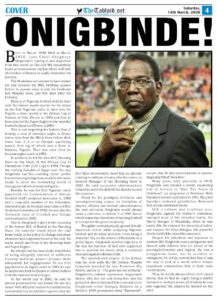
 Born in March. 1938. Died in March. 2026. Late Chief Adegboye Onigbinde’s coming to and departure from this world on 5th and 9th respectively bears an harmonious rhythm which will help chroniclers of history to easily remember his journey.
The Modakeke son seemed to have waited for and allowed his 88th birthday passed before he passed away to join his forebears last Monday dusk, just five days after his birthday.
History of Nigerian football shall be kind with the former pupils teacher for his status as the first Nigerian coach to have won for Nigeria a silver medal at the African Cup of Nations in Cote d’ivore in 1984 and first to have also led the Super Eagles to the mundial hosted by Japan and Korea in 2002.
This is not forgetting his historic feat of leading a crop of untested eagles to Ghana where they beat the Black Stars before their home fans 2–1 at an Olympic qualifying match, first leg of which was a draw in Kaduna, Nigeria. That was soon after he became eagles coach in 1983.
In addition, he led the then IICC Shooting Stars to the finals of the African Cup of Champions Clubs (CAF Cup) in 1984. Though the visiting Zamalek of Egypt won the cup, Onigbinde had his coaching career profile boosted among indigenous coaches who were ready to show the footballing world of managerial talents abound in Nigeria.
Besides, he was the first Nigerian coach appointed the Confederation of African Football (CAF) technical instructor in 1988 and a respected member of the Federation Internationale de Football Association (FIFA) Technical Committee in 1998. He was also the Technical head of Trinidad and Tobago national team in 2002.
Also to Onigbinde’s glory is the renaming of the former IICC of Ibadan to the Shooting Stars, the assertive brand which the club bears today as his policy to change structure, character and corporate brand of the club. He made untold sacrifices to the Shooting Stars and Super Eagles.
He always had the man-made misfortune of being allegedly starved of sufficient training materials players prepare them adequately for engagements. In his first appointment as Eagles coach in 1983, he said he had to run back to Ibadan to collect balls to train the national team in Lagos.
At the world cup in 2002, he said he almost prostrated for and kissed the ass of a senior NFA official to receive his entitlements. Lamentably too, he told this reporter that the Oyo State Government owed him an amount running to millions of naira after his tenure as General Manager of the Shooting Stars in 2002. He said successive admnistrations refused to settle the debt till the date he hosted this reporter.
Noted for his prodigous brilliance and uncompromising stance on discipline of players, officials and football admnistrators, the very articulate Onigbinde would always make a reference to Article 2 of FIFA Statue which states the objectives of running football as to improve the game constantly.
The gaffer enthusiastically quoted this all-important article while analysing Nigerian football and its many potholes. From being a drummer boy on the streets of Modakeke to a global figure, Onigbinde said his trajectory of life was the function of God who supported him to weather the storm when it mattered most and against oddities of life.
The uncelebrated chapter of his history was his stint with the Ori Olokun Theatre Company founded by late Professor Ola Rotimi, author of ‘The gods are not to blame.’ Onigbinde’s cultural expression magnetised Rotimi who did not only bring him into his group but also nicknamed him a natural actor. Onigbinde acted Balogun Ibikunle in a Rotimi’s 1969 production titled “Kunrunmi”, an epic play. He also acted Lawuwo in another stage play titled “Rere Run”.
Many years later, precisely in 2018, Onigbinde was handed a script, requesting him to feature in “Ake: The Years of Childhood”, an adaptation of Professor Wole Soyinka’s memoir published in 1981. He acted Soyinka’s maternal grandfather, Reverend Kuti in that celebrated movie.
Still a culture and tradition man, Onigbinde, against his mother’s resistance, emerged head of his extended family, the Ekerin Balogun of Modakeke, when he was barely 40s. He climbed the hierachical ladder and became the Otun Balogun, the powerful title he held till he joined his ancestors.
Despite his education and exposure to western life, Onigbinde was a polygamist and blessed with children who are proud of his accomplishments and legacy. He ran a polygamous home, not by accident or indulgence; he did by convinction that it was the way of God in a world where female population outnumbers that of their male counterparts.
Thus, he would always affirm, with casual smiles, that he had no regret being a dutiful husband to multiple wives, all of whom he saw and regarded like players he trained on the pitch.

Leave a Reply