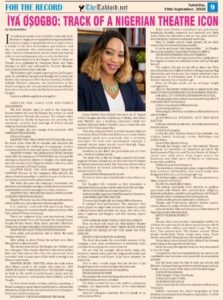
 It is indeed an honour to be invited to review this book. But before I begin, let me say that I have approached this book not simply as somebody who has read it, but as a scholar of the Arts, Performance and Culture—and also as somebody who understands that when an elder’s story is written down, we are not merely reading a life; we are reading a piece of our collective history.
The book before us is Ìyá Òṣogbo: Track of a Nigerian Theatre Icon, published by Honeyson Music and Video Ventures in 2025 and authored by Vincent Akindele, Sola, Dedun & Diran Oyin Adejobi.
The book has eight chapters, moving from Ìyá Òṣogbo’s early life and family background, through her journey into theatre, the emergence of her famous identity, the Oyin-Adéjọbí Theatre Company, the preservation of her theatrical legacy, her own personal testimony, tributes from those who knew her, and finally Itakuroso Pelu Ìyá Òṣogbo.
So, let us walk through the book together.
CHAPTER ONE: EARLY LIFE AND FAMILY BACKGROUND
The first chapter takes us back to the beginning. because before we meet Ìyá Òṣogbo, the actress, we must first meet Grace Ọ̀wọ́ọlá, the woman. The chapter takes us through her family background, her ancestry, her education, vocation and marriage to Prince Joseph Adepoju Oyinlola Adéjọbí.
Ìyá Òṣogbo did not emerge from nowhere. SHE EMERGED FROM OSOGBO
(Chant of Osogbo)
CHAPTER TWO: THE JOURNEY INTO THEATRE, where the book moves from life to vocation and discusses the theatre company, the challenges of managing a theatre company, and the themes and styles of Nigerian theatre
CHAPTER THREE: THE EMERGENCE OF ÌYÁ ÒṢOGBO deals with the emergence of ÌYÁ ÒṢOGBO, her personal life and legacy, important places in Osogbo, the challenges faced by women in the Nigerian theatre industry, and a visual component, Picture Speaks.
CHAPTER FOUR: THE OYIN-ADÉJỌBÍ THEATRE COMPANY focuses on the legendary Oyin-Adéjọbí, the advent of television in Nigeria and the impact of television on theatre practitioners and production.
The book discusses the company’s movement into television, including Kootu Asipa, and the desire to take their transformative moral messages to a wider audience.
CHAPTER FIVE: PRESERVING GRACE OWOOLA OYIN-ADÉJỌBÍ’S THEATRICAL LEGACY
Chapter Five is, for me, one of the most valuable sections of the book from a cultural preservation perspective.
It is explicitly concerned with preserving Mama’s theatrical legacy. by documenting the plays and songs of the Oyin-Adéjọbí Theatre Company.
There are eighteen plays and productions listed, including Hannah’s Trial and Triumph, The Gospel Fruit in Osogbo, Ile Oya, Ekuro Oloja, Kuye, Ipadabo Oduduwa, Olaniyonu, Orogun Adedigba, Kootu Asipa and others.
CHAPTER SIX: FACE TO FACE WITH ÌYÁ ÒṢOGBO
Now, ladies and gentlemen, this is where the book changes character.
After telling us about Mama, the authors now allow Mama to tell us about herself.
The authors interviewed Ìyá Òṣogbo, her children and her colleagues. They explain that these interviews yielded facts and information that had not previously been recorded, with a major part of the book drawing from Mama’s own words.
CHAPTER SEVEN: TRIBUTES, where the book moves what Mama meant to the people who knew her. AND CHAPTER EIGHT: ITAKUROSO PELU ÌYÁ ÒṢOGBO brings us back to the world of performance, music and the theatrical memory surrounding Oyin-Adéjọbí and Ìyá Òṣogbo.
So, It is a book about a woman, a family, a marriage, a theatre company, a generation of performers, a culture and, ultimately, a Nigeria that we must not allow to disappear from our collective memory.
ÌYÁ ÒṢOGBO: THE WOMAN BEHIND THE NAME
Grace Owóóla Oyin-Adéjọbí was born on 23 August 1930 in Osogbo, into the royal family of Okebiyi. Her father, John Okebiyi, was a building contractor, while her mother, Deborah Olabisi Okebiyi, was a trader. She was born in 1930. Think about that.
That was a Nigeria before television became what we know today. Before Nollywood. Before social media. Before Instagram could turn somebody into a celebrity overnight! Yet from that environment emerged a woman whose name would travel through stage, television, film and popular culture.
Greatness is not about the generation you are born into…Ii is about making a mark.
The book tells us that Ìyá Òṣogbo attended All Saints’ Anglican Primary School and reached Standard IV before her formal education ended. She, however, did not allow the limitation of formal schooling to become the limitation of her life.
Ẹ má ṣe fi ibi tí ẹ bẹ̀rẹ̀ pinnu ibi tí ẹ ó dé.
Do not use where you started to determine where you will end.
Ìyá Òṣogbo’s life reminds us that education is important, but education is not the only form of knowledge.
She learnt from life, theatre and experience.
And eventually, experience itself became her classroom.
AND THEN CAME THE THEATRE
The name Ìyá Òṣogbo did not simply fall from heaven.
It emerged from performance. The characters that actors played on stage could become the names by which audiences knew them outside the stage. She chose the name “Lagbenjo Ìyá Òṣogbo,” and that identity stayed with her.
OYIN-ADÉJỌBÍ: MORE THAN A THEATRE COMPANY
Now, we must talk about the Oyin-Adéjọbí Theatre Company. WE REMEMBER THAT THERE NEVER WOULD HAVE BEEN IYA OSOGBO IF NOT FOR BABA WA OYIN ADEJOBI
(CHANT ORIKI BABA OYIN-ADEJOBI)
The book documents the remarkable journey of the company—from stage performances to television, radio and other forms of popular entertainment.
We are told, for example, about Kootu Asipa, the television comedy series, and how stage productions such as Kuye, Laniyonu and Ekuro Oloja were adapted for television.
This is why I would argue that the theatre of Ìyá Òṣogbo’s generation was not empty entertainment.
It was entertainment with responsibility.
ÌYÁ ÒṢOGBO AS MOTHER
But perhaps the most touching dimension of this book is that behind the actress is a mother.
The book presents her as a wife, mother, companion, confidant and dependable member of the Oyin-Adéjọbí Theatre Company.
And her colleagues remember her not simply as an actress, but as Mama.
Baba Lere Paimó remembers her generosity, hospitality, humility, politeness and motherly care. Baba Azeez Fidijá also remembers her as “our good mother,” describing her kindness and godly teachings.
Now, in Yoruba culture, when people call an older woman Ìyá, it is not merely an age marker.
It can be an honour. And responsibility “ Ìyá Òṣogbo. She became a mother beyond her biological children.
THE MOST POWERFUL VOICE IN THE BOOK
For me, one of the strongest parts of this publication is the chapter in which we come face to face with Ìyá Òṣogbo herself.
The authors did not merely tell us about her. They interviewed her, her children and her colleagues, preserving information and memories that might otherwise have disappeared. A substantial part of the book allows Mama’s own voice to come through.
When Ìyá Òṣogbo speaks, we are no longer simply reading history.
AND AT ONE POINT, WHEN SHE IS ASKED HOW SHE WANTS TO BE REMEMBERED, THE ANSWER IS STRIKING.
SHE SAYS, LET THE PEOPLE WHO KNOW ME SPEAK.
And among the descriptions she values is being called “A GOOD MOTHER.” IYA DAADAA
(Chant on Iya Daadaa &Motherhood)
Ladies and gentlemen—
What a legacy! Not that I was famous. Remember me as a good mother.
ACADEMICALLY SPEAKING: WHY THIS BOOK MATTERS
From an academic perspective, this book operates on at least four levels.
First: It is a biography.
It tells the story of Grace Ọ̀wọ́ọlá Oyin-Adéjọbí—her origins, family, marriage, career, challenges and achievements.
Second: It is a theatre history.
Through Ìyá Òṣogbo and the Oyin-Adéjọbí Theatre Company, we encounter an important period in the development of Nigerian and Yoruba theatre & Mama’s career over sixty years, from stages across the Southwest and other parts of Nigeria to television, home video and film.
Third: It is an archive of memory.
The interviews, photographs, plays, songs and tributes help preserve information that could easily have disappeared. Because, as Yoruba people say:
“Bí a bá ń gbé àgbà, a ń gbé ìtàn.” When we preserve our elders, we preserve history.
Fourth: It is a book about values.
The authors repeatedly draw attention to qualities associated with Mama’s life—perseverance, diligence, dedication, kindness, sacrifice and godliness and Mama’s philosophy of love of God and love of neighbour.
This book also provides material for scholars of:
Theatre and Performance Studies; Yoruba popular culture; Women’s studies; Yoruba Oral history;
Cultural studies; Film and television; and the history of Nigerian popular entertainment.
BUT IS THE BOOK PERFECT?
NO
Because this is not merely a monograph written for scholars. It is a memory book whose expansiveness reflects the desire of the authors and family to say: “We were here. This woman lived. This theatre existed. These people performed. These songs were sung. These stories were told. Please do not let them disappear.”
Today, Mama Grace Ọ̀wọ́ọlá Oyin-Adéjọbí has finished performing on the stage of active theatre.
But fortunately, through this book, her story has refused to leave the stage.
I congratulate the Oyin-Adéjọbí family, the authors, the contributors and everyone who made this documentation possible.
May the book travel far. May it enter our schools and libraries. And may future generations open its pages and say: “So this is where some of the story of our theatre began.”
Ẹ ṣé fún fífi ìtàn yìí pamọ́.
To Ìyá Òṣogbo: Prayers for Mama.
(Chant Iya Osogbo’s Oriki)
Àṣà kì í kú bí a bá ń sọ̀rọ̀ rẹ̀.
Culture does not die when we continue to tell its story. Thank you!
Robbin reviewed the above biography at 96th birthday/book launch of Iya Osogbo on September 13, 2026 in Ibadan, Oyo State.

Leave a Reply