 The All African Games (1973). The Festival of Arts and Culture (FESTAC) 1977. The African Nations Cup (1980). The African Champions Clubs final (1984). The African Nations Cup (2000). All these international fiesta were hosted by the multi-purpose National Stadium, the nation’s pride. Today, however, the magnificient facility is decaying at alarming rate. LANRE SOLIU’s report offers a deeper insight into the national shame to which the stadium has been reduced.
It was an eye-opening visit to the National Stadium, Surulere, Lagos State, on January 18, 2026. Evidently, the historic stadium appeared less like a deteriorating monument and more like a place well defined by local aspirations and everyday hustle.
However, the stadium and all its facilities currently depict a painful condition of decay.
The stadium has two main entrance gates, one of which was noticeably busier. From the busier one, the indications of abandonment were obvious. The gates were rusted and destructively worn out.
Some stairways and walkways appeared abandoned and were littered with stone, discarded refuse and broken particles. Paint has peeled off the walls. Large patches of bare concrete were exposed. This gave the stadium a worn and repulsive appearance.
Weeds grow freely around the compound. Blocked drainage channels have left parts of the field waterlogged after repeated rainfall. The stentch from some areas was unpleasant. Security posts looked so tired and poorly maintained.
The mainbowl is in a sorry state screaming for rehabilitation. Thousands of seats are broken, cracked and completely displaced. In some sections, metal seat frames were exposed, making them unsafe for spectators. The concrete steps leading to the stands were worn out and lopsided. Some steps have conspicuous fractures.
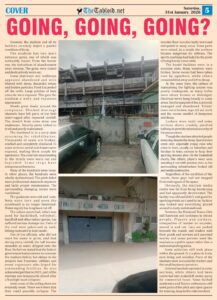 Many of the handrails were loose. In other places, the handrails were wholly dysfunctional. The pitch didn’t meet professional standards anymore and lacks proper maintenance. The surrounding changing rooms were vandalised. The goalposts were old and rusty. Nets were torn and even the scoreboard is no longer functional. Water supply has long been cut off.
The indoor sports hall, which was used for basketball, volleyball, handball and other indoor games, has suffered serious damage too. Parts of the roof were pulverised as such, letting rainwater to leak inside.
One of the officials, who did not want his name in print, said that during every rainfall, the hall became unusable as water dripped onto the floor. He further stated that the federal government had promised to renovate the stadium before, but delays in the projects had frustrated athletes and event organisers who hoped for outstanding facilities. He also acknowledged that in 2023, part of the stadium was temporarily closed after a floodlight mast collapsed.
Some areas of the ceiling show are evidently weak. There were fears that they could possibly collapse. The wooden floor was also badly worn and extirpated in many areas. Some parts were raised. As a result, the surfaces became dangerous for athletes. The sports markings had faded to the point of being barely observable.
The hostel facilities were in a destitute state. Many windows were broken. Some rooms had been taken over by squatters, while others remained shut away and left to decay.
At the same time, the culture of maintaining the lighting system was poorly inadequate, as many bulbs were either broken or dislodged. Electrical wires hung loosely in some areas. Sports equipment lies scattered, damaged and abandoned. Toilets’ doors were broken, taps did not work and the rooms smelled of dampness and decay.
Lockers were rusty and some without doors crudely patched halfway to provide minimal security of the possessions.
Though the stadium attracted people every day, despite the decay. Sports lovers come over, especially young ones who come to train, usually on Saturdays and Sundays to train, exercise to keep their sporting dreams alive. On the Basketball courts, like others, players were seen sweating it out with passion, even as the surrounding infrastructure looked old and neatly unattractive.
Regardless of the condition of the courts, these guys had not stopped from making use of the space.
Obviously, the stadium media centre was far from being functioning and had apparently deteriorated. The facility was old and didn’t look good for sporting events as it used to be. Its door was locked and everything placed around is dusty and abandoned.
However, the Mainland Tennis Club still functions and continues to attract people. Players and visitors, irrespective of insider or outsider, moved in and out. Cars are packed beneath the stands and traders sold their goods and services and operated nearby and some persons used the stadium as a public space rather than a national sporting arena.
Some activities still took place within the ground. It is a place to train, earn living and socialise. Parts of the stadium were occupied by traders and the small business operators.
Informal markets operated in some sections, while others had been converted into makeshift motor parks for commercial buses. Some football academies and fitness enthusiasts still used parts of the pitch and open spaces for training, despite the risks involved.

Leave a Reply