 Late Hubert Ogunde has been described with admirable superlatives, most common and popular of which is the phrase: “The doyen of Nigerian theatre.”
None of the sobriquets intended to flatter. All of them actually exalt Ogunde’s prodigy, his frame, his fame and his larger-than-life presence in the evolution and commercialisation of theatre practice before, during and after Nigeria’s independence on October 1, 1960.
Professor Ebun Clark, a foremost theatre scholar, in her book–Ogunde: The Making of Nigerian Theatre–published by the Academy Press in 1980, studies Ogunde, a former police constable until 1944, and provides an insight into formation and development of theatre viz-a-viz the Ososa-born’s connection.
Ogunde, as a professional theatre practitioner debuted with a play titled “Tiger’s Empire”, which he staged on March 4, 1946. The play was said to be an anti-colonial statement, which drew public attention to him and his theatre company.
Clark wrote: “It could therefore be said that through his theatre Ogunde was a leading figure in the nationalist movement. It could also be said that but for the nationalist support and protection of his theatre through the press, Ogunde’s theatre would probably not have survived.”
Celebrated thespians like late Kola Ogunmola, late Duro Ladipo, late Oyin Adejobi, late Moses Olaiya (Baba Sala), late Adeyemi Afolayan (Ade Love) and a host of others would toe the path laid by Ogunde and also hit limelight and breakthrough. For his pioneering role in the industry, Ogunde emerged the first president of the Association of Nigeria Theatre Arts Practitioners (ANTP) upon its formation as an interest group in 1976.
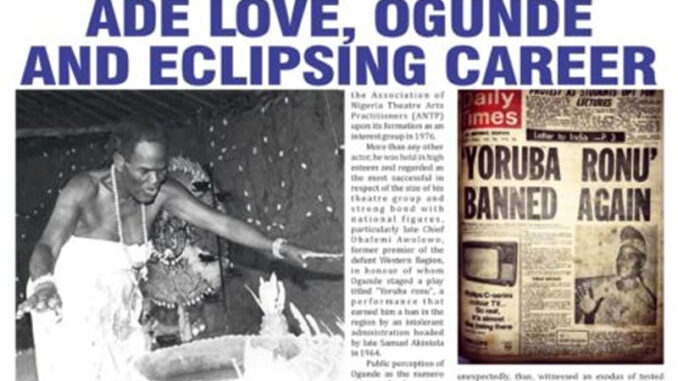
More than any other actor, he was held in high esteem and regarded as the most successful in respect of the size of his theatre group and strong bond with national figures, particularly late Chief Obafemi Awolowo, former premier of the defunt Western Region, in honour of whom Ogunde staged a play titled “Yoruba ronu”, a performance that earned him a ban in the region by an intolerant admnistration headed by late Samuel Akintola in 1964.
Public perception of Ogunde as the numero uno of theatre practitioners might be wrong as he was said to have, at a point in the late 70s, lost the steam and about giving up his career, which he suspected had entered its age of menopause.
A couple of sources had long whispered to TheTabloid.net suggesting that Ogunde and wives alleged mismanagement of his workforce ignited a silent reaction among his staff, and the company quite unexpectedly, thus, witnessed an exodus of tested hands who had, over the years, sustained the group through its regular tours round Nigeria and coastal countries up to the then Ivory Coast.
Faced by this daunting depletion of his staff and fading face of stage performances due to alternative television and radio ststions across the country, Ogunde almost turned a recluse until a moment came, woke him up and opened his eyes to a new possibility of reactivating his career.
One of Ogunde’s reliable staff who, according to him, worked closely with him, Mr Kola Olaiya confirmed that late Ade Love emerged the needed angel in that dark hour of uncertainty.
Hosted by the Agbaletu tv, anchored by Producer, Mr Dele Adeyanju, Olaiya authoritatively said Ade Love visited Ogunde at the most appropriate time, which, he emphasised, became a catalyst in his boss eclipsing career.
“Ade Love visited and encouraged Baba (Ogunde) not to bother himself about searching for staff again. He told him to go into film production because he (Ade Love) had successfully produced his “Ija Ominira” with financial support from his Igbomina businessmen. It was this advice which Baba took that changed his fortune. How?
Olaiya affirmed that Ogunde, without wasting time, sold his land at Yaba, also took a loan from his bank and put the money into production of his epic film titled “Aye” in 1980.
He recalled that the film, though almost gave Ogunde a heart attack at his premier in the National Theatre, Iganmu, Lagos, where about 20 people watched the first show, it turned out a goldmine, bringing unimaginable profits to Ogunde.
The success of that film spilled over to the making of “Jayesinmi”, “Aropinteniyan” and “Ayanmo”, his last till he passed away on April 4, 1990 at the Cromwell Hospital in London. He was 73 years.

Leave a Reply