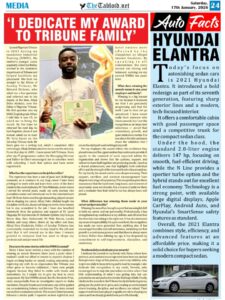
 Mr Segun Adebayo is an assistant editor with the Sunday Tribune where he doubles as entertainment editor. He is a winner of the Nigeria Media Merit Awards (NMMA) at two occasions in 2015 and 2025. Adebayo speaks with TheTabloid.net during which he reveals that he is a journalist by accident. Excerpts
Which schools did you attend and what was your course of study?
I had my elementary education at Unik Nursery and Primary School, Idi-Ishin, Jericho, Ibadan, between 1989 and 1994, where I also served as the Social Prefect. After primary school, my father was keen on sending me to a boarding school, though I did not fully understand his reasons at the time. Looking back, I realise it may not have been unconnected to the fact that I was quite troublesome as a young boy.
How did your growing up look like?
Growing up at Arometa, Eleyele, Ibadan, there was really no hiding place for me or my siblings. We were widely known as the children of Iya Soga, my mother, a famous and highly respected food vendor who ran one of the most popular canteens in Mosafejo/Arometa along Sango–Poly Road. Her name alone carried weight. Wherever we went, once people identified us as awon omo Iya Soga (Iya Soga’s children), that was enough to keep us in check.
Who was your mother?
My mother was a strict disciplinarian who did not spare the rod. She instilled fear, discipline, and responsibility in us early. I was not yet seven when I started running errands for her, while she ensured we read our books and returned home with good results. Her canteen attracted the high and mighty in Ibadan in the 1990s — people like Isaac Brown (The Mayor), Goke Bajowa, and several others whose names I may no longer recall. That canteen was my first classroom in life. My childhood was shaped by the daily interactions I witnessed there. After school, I would return to the shop to help her workers, including pounding yam. By the time I was barely 14, I could pound yam better than most adults, prepare amala, wrap hot eba or amala, and attend to customers simultaneously, especially during rush hours.
Next?
From Unik, I proceeded to African Church Grammar School (Afro), Apata, Ibadan, in 1995, where I met wonderful friends who have gone on to become successful men and women across the globe. I later left at SS1 for personal reasons and enrolled at United Secondary School, Ijokodo, Ibadan. I also had a stint at Cheshire High School, close to The Polytechnic, Ibadan, where I eventually sat for my SSCE examinations in the 2000/2001 academic session. It was a long journey, but I thank God for His grace throughout. I have lived many chapters that could fill an entire book.
Higher institution.
The journey to higher education was another defining phase. In those days, there was intense pressure on students to gain university admission immediately after secondary school. As the second child and first son, my father had high hopes for me and constantly reminded me to stay focused and out of trouble. He strongly believed in his children attaining the highest level of education. I wrote JAMB (Joint Admission Matriculation Board) and several qualifying exams, but admission into the university did not come through. While waiting to try again, my father took me to his uncle, popularly known as Uncle Demola, who was a senior academic at The Polytechnic, Ibadan. He was a meticulous man — always neatly dressed, never without his hat, and often seen with his Peugeot 505. Uncle Demola suggested I apply to The Polytechnic of Ibadan instead of waiting another year. I rejected the idea outright. At the time, I wanted to study Law because, growing up, I had seen many people cheated and abused without anyone to speak up for them. I wanted to be that voice.
What happened next?
 Eventually, my father agreed to Uncle Demola’s suggestion without my knowledge. I was later summoned to his office, where he asked me to walk with him outside. Placing his hand on my shoulder, he told me he wanted me to study Mass Communication. Then he made a statement I will never forget: “If you don’t become successful as a journalist years from now, when I am gone, ask your father to bring you to my grave and spit on it. But if it turns out well, always remember to say a prayer for me.” That ended the discussion. So I graduated from the Polytechnic Ibadan with Upper Credit, Mass Communication Department.
What is your job specification aside entertainment?
I also oversee the politics pages, conduct interviews, and write feature stories.
When and how did you join Tribune?
I joined Nigerian Tribune in 2005 during my mandatory Industrial Training (SIWES). My mother’s younger sister, popularly called Iya Bukky, worked in the sanitation department at Tribune and helped facilitate my placement. She took me straight to the Editor of Sunday Tribune, Mr Edward Dickson, who asked me a few questions and referred me to his deputy at the time, Alhaji Debo Abdulai, now the Editor of Nigerian Tribune. His first question was my WAEC English grade. When I told him it was C5, he asked me to bring the result. By the time he returned the next day, he had forgotten about it and instead asked me to meet Mr Sola Sanni on the Saturday Tribune desk. Mr Sanni gave me a writing test, which I completed. After reviewing it, Alhaji Abdulai asked me to resume the next day. From that day in 2005, I have never left Tribune. Even after my IT programme ended, the Managing Director and Editor-in-Chief encouraged me to combine work with schooling. I took that option and have never regretted it.
What has the experience on the job been like?
The experience has been a mix of good and challenging moments, as is common in any long career. I have been privileged to work with and learn from some of the finest minds in the media industry. Mr Tade Makinde, under whom I served for several years, made my early journey into journalism easier and introduced me to the entertainment beat. Mr Bode Adewumi, though demanding, played a major role in shaping my career. Alhaji Debo Abdulai taught me discipline and focus, always advising me not to chase money but to stay committed to the job. I have also benefited immensely from the guidance and support of Dr Lasisi Olagunju, Mr Seyi Gesinde, Dr Kehinde Oyetimi, Seyi Sokoya, Moses Alao, Dare Adekanmbi, Mr Wale Emosu, Laoulu Afolabi, and many others. Above all, my editor and boss, Alhaji Sina Oladeinde, Editor of Sunday Tribune, has consistently reminded me to stay loyal to the job and trust that it will reward me in due time. I remain grateful to everyone God has used to shape my professional and personal life.
Do you write your stories with the NMMA in mind?
Never. I have never written a story with the mindset of winning an award. However, there came a point when I realised I could not afford to remain in anyone’s shadow. I began working harder on myself, reading extensively, and improving my craft. In an organisation like Tribune, you either grow or become redundant. I have seen people stagnate because they failed to evolve with trends and innovations. So, I simply try to give my best to every assignment. My first NMMA award, the Olu Aboderin Prize, came unexpectedly from an investigative report on Alaba marketers. Despite threats and resistance, my editor guided me on maintaining balance and fairness. The story earned me my first nomination and win. The second, Entertainment, followed a similar path. I reported on how nightclub and hotel owners were affected by the clampdown on alleged internet fraudsters. By speaking to all stakeholders, the story turned out strong and balanced, earning me my second NMMA ten years later.
What does winning the awards mean to you, your employer and family?
Winning is a big honour for me because it reassures me that I am genuinely progressing and that the work I put in does not go unnoticed. I have never really been someone who chases awards, but I see this recognition as an important milestone — proof that consistency, growth, and quiet dedication matter. It is less about the title and more about the validation that I am on the right path and evolving in my craft.
For my employer, this award reflects the confidence they placed in me and the opportunities they continue to provide. It speaks to the standard of work expected within the organisation and shows that the systems, support, and culture we have built together are producing results. I see it as a shared achievement, one that highlights both individual effort and the strength of the team and leadership around me. For my family, the award carries even deeper meaning. Their support, sacrifices, and constant encouragement have shaped every stage of my journey. This recognition gives them reassurance that the hard work, long hours, and moments of uncertainty were worthwhile. It is a source of pride for them and a reminder that their belief in me has always been well placed.
What difference has winning them made in your career and personality?
Winning the award has brought a quiet but meaningful shift in both my career and my personality. Professionally, it has strengthened my confidence in my abilities and affirmed that the direction I am taking is the right one. It has also increased my sense of responsibility. On a personal level, the recognition has made me more grounded than anything else. It has encouraged humility and self-awareness, reminding me that growth is a continuous process and that there is always more to learn. Rather than inflating my ego, it has deepened my commitment to self-improvement, discipline, and consistency.
To whom did you dedicate your awards?
I dedicate the awards to my lovely wife, Nene, whose love, patience, and constant encouragement have been my anchor through every stage of this journey, and to my children, who inspire me daily to keep striving and to lead by example. I also dedicate this recognition to my uncle, Demola, who encouraged me to step into journalism at a time when I had little understanding of what I was getting into, but saw potential in me and pushed me to take that leap of faith. Finally, I dedicate the awards to the Tribune family for believing in me, giving me the platform to grow, and creating an environment where learning, discipline, and excellence are valued. Their support and trust have played a significant role in shaping my career, and I am deeply grateful to be part of that family.

Leave a Reply