There was a man called Nelson Mandela. He did not choose to be a leader; leadership chose him and his people endorsed him. He was blessed with longevity; did one term of five years in office and passed the baton to a successor, Thabo Mbeki, son of his long-time comrade in the struggle, Govan Mbeki. Not that he was too old at the time to continue in office, but he felt that after 27 years in prison he didn’t need to make the office of president an entitlement like Yoweri Museveni has done in Uganda for decades now.
Mandela was o loved by his people that even years after leaving office and age was clearly telling on him, South Africans were praying that he shouldn’t die just yet. Such gracious transition to a successor is a phobia for many African leaders. It is a phobia they are in dread of; a hemlock they dread to drink.
African leaders don’t serve their people. Their people don’t serve them either. But the leaders want the status quo to remain till their demise. They take everything from their countries and give nothing back. To perpetuate this scenario, some intentionally don’t groom likely successors except they have their sons in mind. Their mindset is that a clear successor or deputy may become too ambitious and impatient to ‘wait for his time.’ So, it is smart to keep everyone guessing.
Since 1980 when Zimbabwe got her independence, Robert Mugabe ruled till he went senile and his comrades began to see that he was no longer in charge. If anything, his wife and former secretary was poised to take over from him. At his most vulnerable moment, a palace coup took him off the scene. He died soon after.
As one of the longest serving rulers the world over, Teodoro Obiang Nguema Mbasogo, has been ruling Equatorial Guinea for 45 years. Usurping power through a coup, when he overthrew his uncle, Francisco Macias Nguema, he nominally returned Equatorial Guinea to civilian rule in 1982 and though an oil-rich country, most of his countrymen live in poverty.
Yoweri Museveni, Ugandan president has been in the saddle since 1986 and currently seeking to extend his nearly 40 years in power. From a guerrilla fighter in the 80s, he has permanently entrenched himself into leadership position such that many Ugandans under 40 years old have never known any other president. Since then, he has also won every election held having arm-twisted parliament to have the constitution amended twice to remove age and term limits which has opened the door to allow him remain in office perpetually. His critics argue that his nearly 40 years in power has been with an iron hand.
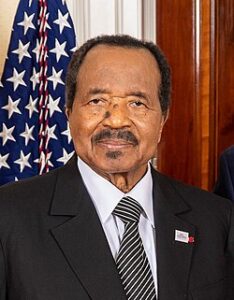
If the aforementioned leaders are in their 80s, Paul Biya is not giving up power at over 92 as he is world’s oldest leader and has been in the saddle as Cameroon’s president for about 44 years, having
taken the rein of leadership in 1982. His predecessor, Ahmadu Ahidjo had resigned from office purportedly on health grounds with an arrangement for Biya to succeed him. Despite this longevity, age-wise and in office, Biya has refused to do what his predecessor did. In fact, he won his eighth consecutive term in office in October last year for another seven-year term amidst nationwide protests including calls from both within and outside the country for him to step aside and allow younger people to rule the country.
If he has been another Lee Kwan Yew in office, the ordinary Cameroonian wouldn’t have minded that he should continue perpetually in office. Despite not being a good performer in office, he keeps insisting that he has been doing well all through the 43 years in office. “Together, there are no challenges we cannot meet,” he was quoted to have said, while trying to cajole his countrymen for another term, arguing that “The best is still to come.” Not many are convinced that he still has anything to offer at an age when his contemporaries are either dead or long retired from public office.
As of today, many of his countrymen are saying “enough is enough” of his lack-lustre rule and that he has “outlived his usefulness.” Even his own daughter refused to endorse his candidacy last October during his campaign.
The question today is: when will Africa be rid of these vermin in office who have clearly outlived their usefulness? This sense of entitlement and becoming president-for-life with abysmal record of under-achievement are at variance with leadership and societal expectations. Surely the continent doesn’t deserve such leaders in the 21st century, they belong to the past and their countrymen would do well to rise up and make them history. The sooner the better.
Dr Adebayo Alade is an academic and Head, Mass Communication Department of Dominion University, Ibadan.
*Published February 7, 2026

Leave a Reply