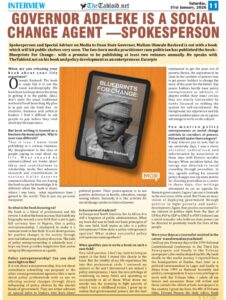
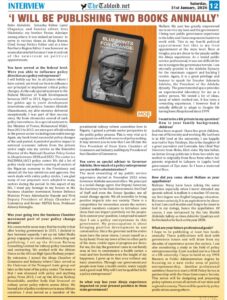
 Spokesperson and Special Adviser on Media to Osun State Governor, Mallam Olawale Rasheed is out with a book which will hit public shelves very soon. The Iwo-born media practitioner cum politician has published the book–Blueprints For Change– with a promise to be publishing at least two volumes annually. He speaks with TheTabloid.net on his book and policy development as an enterpreneur. Excerpts
When are you releasing your book about your life experience ?
The book is ready but it is not the usual autobiography. We have been too busy, hence the delay in getting it to the public. Also,I don’t want the usual traditional method of book launching. My plan is to give out the book free to students, business and political leaders. I find it difficult to ask people to pay before they read about my life experience.
But book writing is treated as a business by many people. Why is your case different?
That is true. I know book publishing is a serious business. My disagreement is the idea of people paying to read about my life. What should be commercialised are books about ideas and contributions to scholarship, books that advances research and contributions in various fields deserve commercialisation. You are buying the book to pay for knowledge. It is different when the book is about where I was born, what experiences have I gained in the world. This is just my personal viewpoint.
So what is the book focusing on?
My book is a blend of professional and life review. I crafted the book in a way that builds my biography around a new field that is yet to gain full currency here in Nigeria, that is policy entrepreneurship. I attempted to make it a seminar book in that field. It is all about passion for positive changes in the society through internal influencing of policy direction. The field of policy entrepreneurship is relatively new. I hope my book provides insight into that sector using my life experience as a guide.
Policy entrepreneurship? Can you shed more light on this?
It is not about entrepreneurship; it is not about consultants submitting one proposal or the other across government agencies; this is more about policy professionals with an eye on effecting societal changes through direct influencing of policy choices by the elected heads of government. They are either advisors or special aides to leaders who have direct political power. Their preoccupation is to see positive deliveries in health, education, energy among others. Sincerely, it is like activists for social change inside corridors of power.
 Is it a course of study yet?
In Europe and North America, Yes. In Africa, it is still a fragment of public administration. What my book did was to flesh out basic principles of the new field. Such topics as who is a policy entrepreneur? How does a policy entrepreneur operate? What makes successful policy entrepreneurs among others?
What qualifies you to write a book on such a new field?
Very valid question. I don’t lay claim to being an expert in the field. I stated this clearly in the book. But the totality of my life experience fits into that professional circle. I reviewed my sojourn so far and I discovered I am indeed a policy entrepreneur. I have the rare privilege of combining so many fields and operating so successfully in all of them. What drove me mostly was the yearning to fight poverty of which I was a childhood victim. I grew up to realise that governmental powers are the best instrument to get the poor out of poverty. Hence, the aspiration to be close to the corridor of powers was to get power holders to change the story of the poor for the better. Top power holders hardly have policy entrepreneurs as advisors or players within their inner circles; they are mostly surrounded by hawks focussed on milking the system for self-enrichment. My background, my experience and my current position place me at a great advantage to write on the subject.
You mention policy entrepreneurs as social change activists in corridors of powers. Did you fall under that category?
It may interest you to note that in my university days, I was a closet socialist radicalised and indoctrinated by association in those days with Eastern socialist Europe. When socialism failed, the energy was diverted to social crusading through journalism. In fact, agenda setting for societal policy changes was my main motive for choosing journalism as a career in those days. Our writings attempted to set an agenda for those in government. I agree I am not a Comrade in the real sense of the word. But I have an inner vision of deploying government through politics to fight poverty and under-development. Again, that passion accounted for my interest in politics right from the days of UPN to PSP to SDP to UNCP to PDP. I believe I am a social crusader who believes state power can be directed to positively touch the lives of the people.
Were your days as a journalist assisted in the career transformation you listed?
I will say yes. From my days at the 1994 National Constitutional Conference to the Third Eye Newspapers and finally to the Tribune newspapers, the media shaped my life. My book dwells on this media journey. I reported from the headquarters at Ibadan, then later as a political correspondent in Lagos and finally in Abuja from 1999 as National Assembly and politics correspondent. It was a rare privilege to work with the Tribune titles. I salute all my bosses and associates those still within and those outside the oldest private newspapers in the country. I greet my boss, the MD of Tribune titles, Edward Dicson; the daily editor, Hadji Debo Abdulahi; Saturday Editor, Lasisi Olagunju; and Sunday editor, Sina Oladeinde; my brother Festus Adedayo among others. It was indeed an honour to serve at various times as Abuja Bureau Chief, Group Politics Editor and at a time Northern Region Editor. I was however an unusual journalist because I was in and out of the newsroom on political appointments.
You have served at the federal level. Were you able to influence policy direction as a policy entrepreneur?
I will boldly say Yes. In all places where I have served, we tried our best to influence our principal to implement critical policy changes. As the only special assistant to the Federal Minister of Youth Development between 2007 to 2011, Nigeria witnessed her golden age in youth development innovations and policies. Senator Akinlabi Olasunkanmi, my able minister, delivered exceptionally. I was part of that success story. My book chronicles several of such policy innovations. As a special assistant to the Minister of Power, Mohammed Wakil, from 2013 to 2015, we were part of bold reforms in the power sector including renewable energy. Again, my book listed successful policy changes of the said period. A period of positive impact in national economic reform from the private sector angle was my service as the Executive Director of the National Chamber Policy Center in Abuja between 2018 and 2022. The center is a NACIMMA/ACCI policy center. We did a lot of policy study and reports covering all sectors of the Nigerian economy to the Presidency and almost all the key ministries and agencies. Our work deals with entire policy circles. I am glad many of our proposals were adopted in many sectors during the period. In this aspect of my life, I must pay homage to my bosses in the business chamber movement, former Defence Minister, Prince Adetokunbo Kayode and First Deputy President of Abuja Chamber of Commerce and former NEPZA boss, Professor Adesoji Adesugba.
Was your going into the business Chamber movement part of your policy change dreams?
It is connected in some ways. But the reality is that after leaving government in 2015, I decided to face business squarely. I set up my Sahel Media group engaging in consultancy, contracting and publishing. I set up the African Railway Consulting Limited for railway policy innovation and contracting. We worked with the African Union on the African High Speed Railway project. By extension, I joined the Abuja Chamber of Commerce and Industry where I later served as the Chairman of the Transport trade group and later as the head of the policy center. The issue is that I was obsessed with policy and anything policy. From 2015, I set up the African Railway Roundtable, another body that focussed on railway sector policy reform across Africa. We hosted a lot of policy conferences in many African countries. I even served as a member of the presidential railway reform committee here in Nigeria. I gained a private sector perspective in the public policy process. This is very vital as it equipped me with both sources of policy making. It may interest you to note that I am till date the Vice President of Osun State Chamber of Commerce and Industry and Deputy President of Iwo Chamber of Commerce.
You serve as special adviser to Governor Adeleke. How much of a policy entrepreneur are you in this administration?
The most rewarding of my public service experience started in November 2022 when Governor Adeleke assumed office. My principal is a social change agent. Our Deputy Governor, the Secretary to the State Government, the Chief of Staff and even the House Speaker, are all social change agents. We all scramble to bring positive impacts into our society. There is a competition for innovation across the sectors. Cabinet members compete to introduce new ideas that can impact positively on the people. So to answer your question, I am proud to assert that I am a policy entrepreneur in this government. My preoccupation is about bringing positive development to our communities. Since the governor and the entire team have the same vision, I count myself as a lucky hand. From my town of Iwo to other parts of the state, visible signs of progress are there. For me, the day the governor came to our family area at Iwo to commission a health center, a road and two boreholes were the height of my happiness. I grew up in that area without any basic amenities. Through our government,our people now have a health centre, water supply and a good road. Why will I not be qualified to be a policy entrepreneur?
In what way has your Abuja experience impacted on your present position in Osun state government?
My past has greatly empowered me to service my boss and the government. I bring vast public governance experience to the table and I have responsive leaders to work with. This is my fourth political appointment but this is my first appointment at the state level. Here at Osogbo, you are closer to the people unlike the Abuja experience. As a tested public service professional, it was not difficult for me to navigate the governance terrain. I am eternally grateful to the Adeleke Dynasty for the maximum support and backing I receive. Again, it is a great privilege and honour to speak for Senator Ademola Adeleke, the President of the Adeleke dynasty. The governmental space provides an experimental laboratory for me as a policy person. We tested a lot of ideas, many of which worked out. It has been a rewarding experience. I however find it initially difficult to adapt to Osogbo life having been Abuja based since 1999.
I want to be a bit private in my question? How is your family background, children?
God has been so good. I have five great children, four out of University and working. My last born is in 400 level at the university. I am happily married to Yeye Tolulope. She is the daughter of a great journalist and Comrade, late Chief Niyi Oniororo from Moba, Ekiti state. My late father, an Action Group politician is from Iwo while my mother is originally from Ilesa from where her parents migrated to Lalupon in Lagelu local government of Oyo state. So I have a maternal root at Ilesa.
How did you come about Mallam as your appellation?
Many have been asking the same question especially when I never attended any quranic school. A mallam is a teacher. Of course, my first degree was English language education. But more seriously, It is an aspiration to be closer to God. I am a sufi muslim and I long to be closer to God in my doings, hence the appellation. Of course, I was turbanned by the late Sheikh Abdulahi Sallaty as Giwa Adini for Quadriya sect for Iwoland as far back as the year 2000.
What are your future professional goals?
I hope to be publishing at least two books annually. Those publications will deal with governance issues and will draw from my decades of experience across the sectors. I am also considering a study in the field of policy entrepreneurship. I just reached out to a friend at a UK university. I hope to build on my 1994 Masters in Public Administration degree by focusing on a new niche area of policy entrepreneurship. Another professional ambition I have is to start a MOR Policy Series in partnership with the Osun Governance Society. This series will be designing and proposing policy options across all sectors of our state and regional economy. There will be quarterly policy publications among others.

Leave a Reply