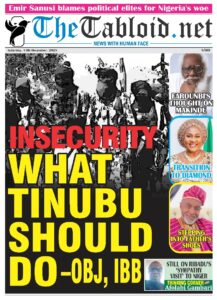
 In face of insecurity threatening the peace and life of the country, former rulers of Nigeria, General Olusegun Obasanjo and General Ibrahim Babangida have shared their respective views with President Bola Tinubu, hoping Tinubu would pick his pen, take note of the recommendations and work on them with his team of service chiefs and other relevant stakeholders.
The plague of insecurity is not Tinubu’s creation; the president inherited it from his predecessors, starting from late former Presidents Muhammadu Buhari and Dr Goodluck Jonathan, both of whom put up some counter measures to end the violence but those reactions yielded no significant results, except alarming expansion of the insurgency’s frontier from northern part of the country, its starting point, to the peaceful south.
It is no longer news that the abductions and killings have assumed a global dimension, thus, causing Nigeria, arguably the most populous black nation on earth, an international embarrasment, especially when the 45th US President Donald Trump, in November, broke his long silence and issued what sounds like both warning and threat to Nigerian government. He wrote on social media that the US would go in guns-ablazing” if the Nigerian government “continues to allow the killings Christains.”
Aftermaths of this yellow card saw the federal government speedily reactivating its fight against bandits and their twin brothers, terrorists.
Tinubu, through the National Security Adviser, Mallam Nuhu Ribadu talked tough and in words devoid ambiguity against individuals or gang constituting a threat to national security.
At a Northern Nigeria dialogue on violence prevention, Ribadu revealed that the government had recorded 775 terrorism-related convictions, saying that sustainable peace requires translating discussions into practical actions that rebuild trust.
He assured that security agencies would remain firm in their duties to protect citizens, seeking understanding as well as support from community and religious leaders.
Ribadu was also in Washington D.C. where he had held meetings with the US Defence Secretary, Pete Hegset and Chairman, Joint Committee of Chiefs of Staff, General Dan Caine. TheTabloid.net gathered that though the meeting held at the Pentagon lasted behind closed door, a statement confirmed that Ribadu and his team were received. That was in November.
During this week, Ribadu hosted a U.S. Congressional delegation in Abuja on what is called a fact-finding mission to Nigeria and second leg of the first bi-lateral engagement.
It was learnt that members of the US delegation included Rep. Mario Díaz-Balart, Rep. Norma Torres, Rep. Scott Franklin, Rep. Juan Ciscomani, and Rep. Riley M. Moore.
Also in attendance was the U.S. Ambassador to Nigeria, Ambassador Richard Mills, also attended. They all reflected on the seriousness with which the US and Nigeria attach to the issue.
Ribadu confirmed that their discussions centred on counter-terrorism cooperation, regional stability, and strengthening Nigeria–U.S. strategic security partnership. He expressed his optimism that the meeting will deepen trust, collaboration, and shared commitment to peace and security between the two nations and beyond.
What did Obasanjo say?
“When I talk about four things, intelligence, training, equipment and technology, I know what I am talking about, and of course, when you get all these right, you must also get the attitude right that you really genuinely want to fight the security.
“If we do not give our children education, then they are liable to become a problem in future, but in trying to give our children education, security becomes an issue.
“So, if we don’t deal with the issue of insecurity, we are compounding this problem because those children who do not go to school when they should go to school will become a liability and a greater problem of security to us.
What did Babandiga say?
“No bandits, no terrorists, no terrorists negotiators or terrorists sympathizers should be spared for disrupting the peace of Nigerians.
“If I was the President, that would be my message to the Nigerian military and states governors. We can go band for band, we are not negotiating!”
Published on December 13

Leave a Reply