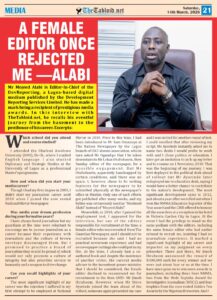
 Mr Mojeed Alabi is Editor-In-Chief of the DevReporting, a Lagos-based digital medium published by the Development Reporting Services Limited. He has made a mark being a recipient of prestigious media awards. In this interview with TheTabloid.net, he recalls his eventful journey from the basement to the penthouse of his career. Excerpts
Which school did you attend and course studied?
I attended the Obafemi Awolowo University (OAU), Ile-Ife, where I studied English language. I also studied Diplomacy and Strategic Studies at the University of Lagos as a professional Master’s programme.
How and when did you start your media career?
Though I had my first degree in 2005, I didn’t start my journalism career until 2010 when I joined the now rested National Mirror Newspaper.
Was media your dream profession during your formative years?
I have always loved journalism but my guardians at the time were reluctant to encourage me to pursue journalism as a career because their experience with journalists and the culture of brown envelope discouraged them. But I promised to practice a brand of journalism they would be proud of, which would not only promote a culture of integrity but also prioritise service to humanity and a weapon to drive change.
Can you recall highlights of your career?
The most significant highlight of my career was the rejection I suffered in my first attempt to be employed at National Mirror in 2010. Prior to this time, I had been introduced to Mr Sam Omatseye at The Nation Newspaper by the Lagos branch of OAU alumni association, who in turn asked Mr Ogundipe that I be taken downstairs to Mr Lekan Otufodunrin, then Sunday editor of the newspaper, for a possible engagement. But Mr Otufodunrin, apparently handicapped by certain conditions, said there was no space. I, however, chose to be writing features for the newspaper to be submitted physically at the newspaper’s office in Mushin. Only one of such efforts got published after many weeks, and my byline was erroneously used as “Moshood Alabi” instead of “Mojeed Alabi”.
Meanwhile, in 2010, after I passed the employment test, I appeared for the interview, but one of the editors responsible for recruitment at the time, a female editor who was recruited from The Guardian Newspaper, said I should not be recruited because she said I had no practical newsroom experience and had no newspaper cuttings she could put in my file. At the time, I already had a co-authored book and despite the insistence of another editor, the current media adviser to the incumbent power minister, that I should be considered, the female editor declined to recommend me for recruitment to the then GMD- Mr Jimoh Ibraheem. However, when Mr Steve Ayorinde joined the team ahead of the rollout, someone again presented my case and I was invited for another round of test. I could recollect that after reviewing my script, Mr Ayorinde instantly asked me to name two desks I would prefer to work with and I chose politics or education. I later got an invitation to pick up my letter and to resume on 1 November, 2010. That was the beginning of my journey. I was first deployed to the political desk ahead of rollout but Mr Ayorinde later redeployed me to education desk, saying I would have a better chance to contribute to the nation’s development. The most significant development came in 2012, just about a year after we rolled out when I won the NMMA Education Reporter of the Year award and the GMD offered to honour all the awardees at a reception in his hotel in Victoria Garden City in Lagos. At the event I had the privilege to stand on the same podium with the editors, including the same female editor who had earlier refused to recruit me, insisting I had no journalism experience. It marked a significant highlight of my career and impacted on my judgment on every jobseeker. There and there, Mr Jimoh Ibraheem announced the reward of N100,000 each for every winner and we were just about four or so at the time. I have since gone on to win more awards in journalism, including three from NMMA, two from the Wole Soyinka Award for Investigative Journalism (WSCIJ) and four trophies from the now rested Golden Pen Awards by the Nigerian Breweries. And I must add that since that first application to join National Mirror, I never applied to other media houses I have worked, rather, I have always been headhunted until 2024 when I left Premium Times as its pioneer development editor and founded DevReporting as a niche media and cinematic platform.
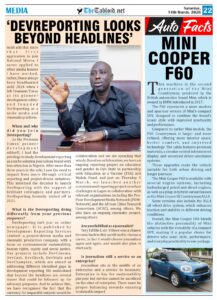 When and why did you join Devreporting?
As the Premium Times’ pioneer development editor, I had the privilege to study development reporting as a niche solution journalism brand with less attention in Nigeria. After more than three years in the role, I saw the need to impact lives more through critical reporting and project-driven initiatives. This informed the decision to launch DevReporting with the support of brilliant colleagues and partners. DevReporting formally kicked off in 2025.
What is the Devreporting doing differently from your previous stopovers?
DevReporting isn’t just an online newspaper. It is published by Development Reporting Services Limited- a project-driven media and cinematic production company, with a focus on environmental sustainability, human rights, equity and social justice. Our projects include DevCinema, DevCast, DevCheck, DevStats and DevChampion, which are aimed at addressing different identified gaps in development reporting. We understand that beyond the headlines are several issues that could be followed up for advocacy purposes. And to achieve this, we have recognised the fact that the currency for impactful outputs would be collaboration and we are spending that wisely. Based on collaboration, we have an ongoing reporting project on education and gender in Oyo State in partnership with Education as a Vaccine (EVA) and Malala Fund, and just on Thursday 5 March, we launched another commissioned reporting project on urban challenges in Lagos in collaboration with relevant organisations including the Pro-Poor Development Media Network (PDM-Network) and the African Cities Tesearch Consortium (ACRC), among others. We also have an ongoing cinematic project, among others.
Are you fulfilled as a journalist?
Very fulfilled, sir. If there was a chance to come back to this world and to choose a career, in fact I would choose journalism again and again, and would also plan to start early.
Is journalism still a service or an enterprise?
Journalism sits in the middle of an enterprise and a service to humanity. Enterprise is key for sustainability purpose but service cannot be sacrificed on the alter of enterprise. There must be proper balancing towards ensuring sustainable impact.

Leave a Reply